Showing posts with label 10 Questions. Show all posts

Sunday, June 12

10 Questions with Giles Reaves!


Giles Reaves, aka "Selig" on the PUF, recorded and produced his first solo project, Wunjo, for MCA back in 1986. Tracks from the album were picked by the national Hearts of Space public radio program and played heavily. From there Electronic Musician Magazine went on to call Wunjo one of the top electronic albums of all time! It is with great pleasure and honor I bring to you this edition of 10 Questions with Giles Reaves:

- You work out of Nashville, a town famous for lapsteels, acoustic guitars, and cowboy boots - how did you get into synthesizers and what is your background in music?

I first heard about synths as a young boy when I lived in Gainsville, FL (my original hometown). My older brother is a radio engineer who got his 3rd Class Radio License when he was something like 13 years old - I would have been 7 at that time, and he was already building electronic circuits in his bedroom which was next to mine. I think the smell of solder went to my head! He knew about synthesizers and talked about them, pointing them out on records like Abbey Road (The Beatles) when that first came out.

Fast Forward to Jr. High and High School in Huntsville, AL. A teacher’s husband had a Paia synth he let me borrow for a few months around grade 10, and that really lit a fire. I have notebooks from that time where I’m designing my own synth, and some proto circuit boards my brother helped me with at one point. But it never went further, with music (drums/piano) competing for my time and creative interests. On growing interest around that time was in the recording studio, but there were only a few small ones in the Huntsville, AL area. But when my best friend’s older brother moved to Nashville to build a studio, the stage was set for my eventual arrival. But first, it was off to U of U in Salt Lake City for my freshman year of college (on a percussion scholarship, so I couldn’t pass it up). After only one year the Recording Studio call was getting louder than the percussionist call, and I transfered to Belmont College in Nashville. My original goal was to learn all about recording in Nashville, and then move to LA or NYC from there. During the 80’s my brother lived in NYC and my folks lived in the LA area, and in multiple visits to both coasts, I soon realized that I didn’t see myself living in either city. Back in Nashville, not being a country music fan, I had managed to find all the ‘cool/misfit’ bands that were doing punk, reggae, space music, goth, techno, industrial, electronic, jazz, roots, you name it. It was a real ‘music city’ right under the surface just waiting to live up to it’s name. So after a few years I gave in and choose Nashville as my ‘home’, with a personal mission to make folks more aware of the OTHER music that was everywhere, and help the city live up to the name “Music City”.

My musical background is that I’ve played piano all my life (don’t remember NOT playing piano), and studied drums beginning in the 7th grade officially, continuing my percussion education up through my freshman year of college. So I’m basically self taught (plus a few years of music theory) on keyboards, and ‘school taught’ on percussion. I got my first drum kit in the 8th grade, but never actually officially studied ‘drum set’ as an instrument. I started programming drum machines in the early 80s (Linn Drum!), and got more into drum programming since I was a keyboard player AND a drummer (and keyboard players were the first ones with drum machines, not drummers!). My first full time studio gig saw me running a production room with a 24 track Studer tape machine, access to the main studio’s mics and Bosendofer piano/B3/Rhodes/Clavinet, plus the production room’s Fairlight CMI, DX7 AND DX1, Jupiter 8, Oberhiem Pro One and DMX drum machine, Simmons SDS5 and (rare) sequencer, and probably a few instruments I’ve probably forgotten about! That room is where I began to ‘put it all together’ for my musical direction, even ‘prototyping’ the music for my first solo project (“Wunjo”, MCA/Master Series 1986).

My entry into the world of Reason (and working totally in the box with synths) was when I had a gig building backing tracks for an Aaron Carter tour (2003). I no longer had my Sample Cell because I had upgraded my computer, so to build these tracks I needed a sampler for starters. Reason was at v2.5, and after a short demo I realized that it had more than enough power for what I was looking for. I used Reason for all the instruments (drum loops, samples, horns/strings, etc) on the backing tracks for his “Aaron’s Juke Box” tour, my first ever use of Reason (showing me just how easy it was to grasp). 

- You've worked as an engineer and producer on a wide range of music.  From Industrial (Dessau) to Country (Chet Atkins) to Southern Blues (Derek Trucks Band), is it difficult for an engineer to work in so many different styles/genres and how did you get your start in engineering?

The first engineering job I got was when the singer of a band I was playing drums in started dating a local studio engineer in Nashville named Marshal Morgan. I got up the nerve to ask him if I could sit in at the studio and learn, and he said yes and apologized that he could only pay me $5/hr (I was making $2.75/hr dipping ice cream before that!!!). The music was all ‘mainstream country’ (Mickey Gilley, Anne Murray, Nitty Gritty Dirt Band, Osmond Brothers, etc), but it was RECORDS being made. I only had this job for a few years before moving up to a full time studio job at Castle Recording outside of Nashville. That studio was owned by a European family who was into all sorts of music, from their own family bluegrass band, to dance music and synth pop - I had found my ‘home’ for the next few years. From there I slowly went ‘independent’ as it’s called, and began my musical career as well...


- Having worked on both the production and engineering side of music creation which do you prefer and how are they alike/different?

I have only recently realized how unique my musical experience was, mainly by having had a small home studio from 1986 onward (before they were even that common), while simultaneously working in major studios around Nashville (which was during a time when the technology was really moving fast, and Nashville studios actually moved ahead of NYC and LA by embracing the digital revolution more fully in the early days). 

At home I had to work within pretty strict limits, while at work I had an almost unlimited playground! So I begin cross-pollinating between those two worlds by sometimes enforcing artificial limits in the big studio (to ‘force’ creativity), and sometimes bringing in expensive gear to my home studio (to enhance the audio ‘quality’). Constantly moving between these two worlds has given me some unique insight on how to combine the best of both, which has served me well as big studio use has diminished while home studio use has grown. The natural progression has been that I’ve done more traditional engineering jobs at big studios, and more production work at smaller studios. But I’ve also been a studio musician during this same period, which is yet another role I play in the studio (big and small). 

But I would have to say that my FAVORITE studio experience is when I can bounce between all three roles on a single project, which actually happens fairly often especially out here in Utah where projects tend to be more self-contained (read: small budgets). For the small budgets, it helps to be able to hire one person who can produce, engineer, arrange, and play half of the instruments! This is more common with singer/songwriters than with bands, where I tend to produce/engineer more than arrange or perform.


- Recently you wrapped up a tour with Emmylou Harris in which you performed on Letterman!  On the tour you play both keyboards and drums at the same time!  Tell us about the set-up you used for this?

I’ve played piano all my life and drums staring around age 13. I’ve often wondered how I could combine them, but never found the right approach. When Emmylou asked us (myself and producer/guitarist Jay Joyce) to join her for a few promotional shows (because we were the ones that played on the latest record), we both had to step up and do things we had never done before. Jay added Moog bass pedals to his guitar rig (playing on almost half of the songs), and I combined drums with keys and/or key bass. I had originally considered using all real instruments (like in a promo video we shot after recording the CD), but I soon realized I would need to go ‘electronic’ for this approach to work as a ‘touring’ setup. 

So I combined parts of my V-Drum setup with a USB keyboard, and moved things around until I found a fairly comfortable setup. From there I had to program the drums and keys to be flexible enough to cover the 13 songs from the CD. On the recordings  I played moog bass, drums, various percussion, piano, ‘plucked’ piano, rhodes, wurly, vibes, pump organ, marimbula (bass kalimba), B3 - obviously we couldn’t bring all of those on tour! So I quickly realized that Reason/Record was going to be the software ‘heart’ of my setup. I’ll be covering this setup on my webcast as a part of the Propellerheads Music Making Month this May 2011.


- Your own music has been quite successful, including the album "Sea of Glass" which reached #11 on the New Age charts shortly after it's release in 1992.  I've heard your sound described as "space music", which is a genre I have to admit I'd never heard of before, where did that description come from and do you feel it adequately describes your sound?

Back in the 70s it was also called Ambient Music, but that name was later used for a different genre causing confusion. Space music was coined by (IIRC) Steven Hill (Hearts of Space Record, who released “Sea of Glass”) to try to re-define the genre. In 1986 I did my first solo release for MCA/Master Series titled “Wunjo”, which was my reaction to the more aggressive music I worked on during the day. The original songs for Wunjo came from late night sessions after my day job. Everyone would leave the studio after the session, but I was still a bit wired (and all the gear was still on), so I’d put in a blank cassette tape (remember those?) and hit record and just jam out. But the thing is, although I was wired I was also tired, so the music I ended up recording on those evenings was mostly slower stuff with no drums or drum machines. I even had a DMX, a Fairlight and Simmons drums (as well as acoustic kits!) all available, but the music that came out late at night was more subdued and calming. It didn’t hurt to be all alone out in the country in a studio that looked like a castle! 

There wasn’t tons of overdubbing on the final release, keeping more to the ‘improvised’ spirit of the original cassette tapes (but I re-played all the parts rather than try to use the actual tapes). It was those very cassette tapes that I used to get the first record deal! BTW, Wunjo had an interesting distinction at the time in that it used no multi-track tape (it was entirely MIDI sequenced), and was mixed direct to digital (this is 1986, so it was a big deal at that time). That was a big thrill for me at the time (as an engineer!), to release an ‘all digital’ CD when most releases of the day still had an analog component of the production, which for quieter music really made a difference. If nothing else, the noise was almost non-existent on this project, which would have been a concern for a quiet and sparse production like this if we had mixed to analog. 

But as to the description “Space Music”, yea it seems to fit as well as anything. But I never think ‘genre’ when I’m writing and producing my music. It always seems weird to me to hear folks asking how to produce a certain genre, especially in the dance world where every artist IS practically their own genre. I tend to refer to artists rather than genres myself, and I tend to take one idea from one artist, one from another rather than try to recreate an artist’s or genre’s ‘sound’. But I also wouldn’t put all my music into the Space Music genre, not by a LONG shot! ;-)


- Having released albums on both major (MCA) and independent labels (Hearts of Space, Space for Music) what's your take on signing record contracts and in the age of the internet are record labels as necessary as they once were for distribution?

I’ve not been a fan of the big labels (for anyone but the big artists) for years. Having experienced both, I can say that in the end I’d rather deal with the mid-level ‘indy’ labels over the really big (or really small) labels. In my experience, I have always preferred dealing with the small to mid-sized operations where you can always get on the phone and talk directly with the ‘top dog’. My experience with larger labels was totally the opposite, where no one in charge was ever accessible, unless you are a ‘top’ artist. So that’s what I mean by big labels not being a good fit for anyone but a top artist. As for the future, I’ve all but given up on trying to guess where things are going next - I’m just hanging on for the ride!

- Are you currently working on any new solo material?

I have stuff laying around that really should be put into some form or another. At times I have felt somewhat restricted (my own doing) by the ‘ambient’ label of my earlier work, and have tried to put more rhythm into some projects. But I guess I still get most of my drumming out of my system on other folk’s projects, but I never get to really ‘space out’ on those projects, so that’s what often comes out when I’m alone! But yes, I DO plan to finish a solo project within the next year. It’s weird how my own projects always take a back seat to anyone else’s, either a friends or a paying client’s. 

Maybe it’s not a problem that many other readers will be able to relate to, but working on music full time can actually make it more difficult to produce your own music, not less! Working on other projects also seems to lead me to more ambient pieces because I’m sonically-exhausted after listening to music all day. :-)

I also have a side project with Portland OR electronic musician and mad scientist Dave Fulton. We have one project out on Hypnos Records from a few years back, and are trying to finish some projects for release in the near future. In both cases there are individual songs that are pretty much finished, but I’m such an “album” guy that I put off releasing anything until there’s enough for an album. Speaking of ‘album’, Dave's suggestion is that our next project be released as a download and vinyl. Cool with me!


- Let's switch gear - you've done the last few Record U tutorials for Propellerheads, which I really enjoyed.  Did Propellerhead come to you with the topic initially and are you going to be doing any more in the Record U series?

Yes, the Propellerheads came to me asking to write one article and see how we both felt, and have since asked me to stay on and do a few more! I’ve been writing part time for Recording Magazine for many years now, so I’m no longer a stranger to technical writing. In fact, I seem to actually enjoy it, and the positive feedback I’ve received so far has really encouraged me to continue further down this path. I would one day like to host my own hybrid tutorial world (for lack of better words) that presents tutorials in a way that combines the best of blogging, webcasting, written and video tutorials, and the online forum into a single concept. Film at eleven. :-)

- In addition to the Record U tutorials on May 30th you're doing a live video cast as part of Propellerhead's May Music Making Month event (this interview was done in mid-May). What can we look forward to in your presentation and is this going to be recorded at your home studio?

I’ll be ‘web-casting’ from the studio I run (with manager Rob Duffin) in Draper UT (South SLC county) called Annex Recording. This is where I do my larger projects and work with clients, when I’m not working in Nashville. 

I plan to cover my live setup from the Emmylou Harris gigs, and live setups in general. I also plan to cover the general topic of cross-pollination between the acoustic and electronic worlds, something I’ve come at from both directions! From there I have a handful of prepared directions I could go, and many more free-form directions that could be suggested by host Ryan Harlin or anyone in the chat room. So you never know, I could be showing SSL tricks, synth programming tricks, arrangement tricks, mixing tricks, who knows!


See Part 2 on PropellerheadSW Youtube page!


- And finally, speaking of home studios, what gear makes up your workplace?

Currently at home (my ‘personal’ studio), I run a Mac laptop with a Digi/Avid interface, and use a USB keyboard. I also have a Fender Strat on hand for what I like to call ‘playing’ guitar. Now here’s the funny part: my small monitors are in the shop and I’ve been using my Roland “Cube Monitor” and headphones for most recent work. I also have a sub-woofer to help fill out the bottom end. The thing is, the cube is MONO (and dual concentric, so all sound really does come from one point!).  For composing and generating ideas, this is great because I don’t tend to get hung up on the mix aspects or worry about panning. I use phones when I need to deal with stuff like that, but as I don’t really mix here it doesn’t matter. In fact, I’m going to keep this setup even when the ‘stereo’ monitors are back!  There really is a difference between ‘creating a song’ and ‘producing a track’ - I guess I learned my craft when they were two different jobs done by two different people, so I tend to keep wanting to work with a similar mentality even when working alone. But I’m not saying ‘don’t mix at all’ before the actual mix - I actually do a bit of mixing while I’m working, I mean, you can’t really get into a song if the mix totally sucks, so it has to at least ‘be close’ so you can work out the parts!  But I have learned that you can easily get distracted with mix decisions before the song is even ‘a song’, and that can actually de-rail the creative process for me.  So (as always) my setup’s limitations are currently serving me well and there’s no need to change what’s working!

Thanks Giles for the great interview!


Video courtesy of campacavallo
Sea of Glass track courtesy of bp996959
Thursday, March 24

10 Questions with Ryan Harlin!


Usually when I ask someone if they're interested in doing an interview I know quite a bit about the person. With Ryan Harlin, I only knew of his top rate video production work for Propellerhead. Serendipitously I found out while researching for the interview that he was part of an electronica duo that I'd discovered years ago on Sirius satellite radio. With this edition of 10 Questions we'll talk about Ryan's work with Propellerhead, his own musical creations and years spent running a recording studio in Philadelphia. Without further ado.......

- First off, where were you born and what was your first instrument?

I grew up in Philadelphia, Pennsylvania.  My first instrument?  That depends on how I count.  My instinct would be to say "guitar" but I played cello in 3rd grade.  The only reason I picked cello in school was because I wanted to play guitar.  I never practiced cello with a bow in the traditional way.  I turned it sideways on my lap and strummed it to make the closest approximation I could to a guitar.  At age 9 my brother got a guitar for Christmas and I got a crash cymbal.  My parents decided Jesse would learn guitar and I would learn drums.  Their plan was to buy me one piece of the kit at a time.  Even at age nine I understood the fallacy of their plan:  what the heck is a kid going to do with a crash cymbal and nothing else?  So I stood in my room (since they hadn't gotten the drum throne yet) hitting a very nice zildjian crash cymbal until my brother lost interest in his guitar and I quickly took over.

- Tell me about your background in music and video production, I know you studied at the Liverpool Institute for Performing Arts, was your time there spent on music or video production?

My background is in music production, performance, and engineering.  From the time I got my first Tascam portastudio I was hooked on recording.  I was very fortunate because despite their misguided plan to buy me a drum set starting with the most obscure pieces first, my parents were incredibly supportive of my interest in both music and technology.  Shortly after my adventures with the portastudio my dad and I went to our local music store and bought all we needed to set up a pretty sweet home studio for that era.  It was a Tascam DA-88 digital recorder, a Mackie 24-8 bus mixer, some Alesis outboard gear, and a couple mics.  I still think the best thing I ever did in my education process was I didn't turn anything on or plug a single thing in for two weeks after getting home.

I probably was driving my parents a little nuts because their big investment was still sitting in boxes in the home office but I didn't want to start using anything until I understood it through and through.  I sat, read, and reread those manuals until I could recite large sections by memory.  You have to understand this was before the internet.  These manuals were the most amazing resource I had yet seen about recording, signal flow, compression techniques, etc.

My interest in recording only grew from there and after high school I started looking for a college that had a full degree program.  That search sent me to Liverpool, England where I attended and graduated from the Liverpool Institute for Performing Arts in 1999.  At the time, video production wasn't a big part of the course but it was something I took to.  I often found myself seeking out video projects to work on - though still doing audio post for them and not production.  In my final year we had a class on documentary production and my friends and I cooked up a scheme to travel to Russia to document the latest economic collapse it was suffering at the time.  That was my first role in the production side of video.  It was a natural lateral move for me because the tasks are so similar to audio production in my view and it even brought in a bunch of the visual design skills I had been developing in programs like Photoshop.

- Before you studied in Liverpool you were running a recording studio in Philadelphia.   Tell us about your work there and are you still involved in music production professionally?

Yeah, my studio!  This was back in the days when you could run a small project studio and bands who didn't have access to home recording would book it.  I ran it for a few years, doing various bands ranging from singer/songwriters, punk, to jazz.  It was a great learning experience but I realized how much more I enjoyed working on projects that were personally satisfying to me.  I mean if I perfectly captured a jazz band's sound as they saw it I really had only successfully fulfilled their vision, not mine.  I much preferred when I was working on something that was a creative outlet for me.  So after graduating, I closed up shop and moved out to California where I pursued any project that allowed me to be personally creative.  Some of that is in the music I make and some of that is in the visual work I do.


- I love the videos you do for Propellerheads!  What software and hardware do you use to create them?

Thanks!  I've been really happy to hear from people who are enjoying what I do.  I've been with Propellerhead for almost a year now and the second half of the year has been fun because when I go to interview an artist now, they've seen some of my previous interviews so they kinda know what to expect and they seem to be excited to work with me.  One artist I was with called up their friend and said "Hey guess who I'm hanging out with now? The guy who did that Adrock video I showed you."  So that's kinda fun.

As for hardware/software, there's nothing too revolutionary about what I use.  I edit in Final Cut Pro, do special motion graphics in After Effects, and I shoot interviews with a Canon 7D and a small army of Nikon prime lenses.  I actually do my audio post-production mixing in Record 1.5.  Sure I have to rewire it to Logic to get video sync but I've found Record to be my favorite audio post environment I've ever used.  The way I can route complex splitters for multi-channel sidechain compression to do audio ducking, draw in my automation, and generally work in the fast pace I need has been a very nice surprise for me.

Far beyond software and hardware, though, I have spent many years working on two far more important ingredients of the production process:  constructing a narrative in the edit room and putting people at ease in the interview chair.  Those are two things that you can't solve through software.  Coming from a musical background, there's a similar practice that they require like learning an instrument.  You suck at first but you get better and better, hopefully.  I'm always learning.  In the same way that a great guitarist can sound amazing on a cheap guitar and a bad guitarist doesn't get better by playing a vintage Fender, these narrative and interactive skills have far more of an impact on what I do than the software or hardware I use.


- How are the Props promotional and tutorial videos generally scripted?

I'll split these up into their two styles since the promotional videos and tutorial videos are dealt with differently.

The promotional artist interviews aren't scripted and they're never paid for.  In fact, the biggest bummer for me is when people say things on forums like "he was paid to say that"  or "I was almost believing he was sincere until I came to my senses."  I am extremely grateful to these artists that allow me to come into their homes or studios and volunteer half their day for my interview.  Without exception, they do it because they love our software and just want to share their love of it with the community.  I suppose it's the tendency for people to be jaded and think that marketing videos must be manipulated and paid for but we think that would defeat the purpose and it would be completely transparent if these guys were just reciting our talking points.  In the past year I have found that these artists are as much or more excited to meet one of the Propellerhead guys in person than I am to meet them.  The enthusiasm or appreciation they express in their interviews is genuine and all their own.

Aside from those, we do script the things that you hear Frank Sanderson saying - which are micro tutorials and feature announcement videos along the lines of what we did in May to announce Reason 5.  Actually, I've met a few people now that are taken aback when they meet me because I don't sound like Frank.  They say "but I thought you do the micro tutorials."  They're right.  I do but Frank reads what I've written.  Believe me, I was not born for a life of voice over work.  If you want to hear my speaking voice just listen to the off-camera guy in some of the deleted scenes videos we've done with Adrock, Printz Board, or Hank Shocklee and then you'll understand why Frank beat me out for the job.   ; )

To answer your question about the "how" of the scripting process, it's pretty natural.  We'll have an idea we want to get out there - usually a micro tutorial - and we'll draw up some bullet points of what ideas we need to include.  From there I usually take about a half day to work up a script and I send it off to Frank.  He's super fast so I usually have his voice over file back in a couple hours and I can start animating over the top of it.  Frank's been fun to work with because we're learning to predict each other's style.  I'm getting better at writing lines I know Frank can deliver well and Frank's learning how to interpret the words on the page in exactly the way I imagined him saying it when I wrote them.  This is especially true for the little joke gags that appear in our micro tutorials.


- How did you hook up with Propellerheads and is it a full-time gig?

I've known those guys forever.  My partner Lisa in Techno Squirrels (see next question) is friends with Tage Widsell who is Propellerhead's Creative Director of Marketing and has been with Propellerhead since 1997.  I would often see them at the NAMM show in LA and they got to know me, they knew I was doing documentary films, and that I specialized in bands and music stories.   A few years back Tage called me up to see if I would like to do some filming at the NAMM show for them, which I did.  Then a year later he asked me to do their Jason McGerr ReFill video.  From there the relationship just continued and in November of 2009 I did their Soul School release video.  That was a big hit around the office and it was a big hit on music sites too.  Propellerhead had been looking for someone to come aboard full-time with them and I think our plans just kinda lined up at the right time.  When they asked me to join the company, I was only too happy to say yes.  I've been a ReBirth user since 1996 and a Reason user since version 1.0 so I'm as much a fan of the company as anybody.


- A few years ago I was working as a bellman for a ski lodge.  Our vans there had Sirius Satellite radios and I was surprised to find out when researching for this interview that you are part of the electronica duo the Techno Squirrels, who I "favorited" years ago when driving guests to the airport.  Are you still making music with the Techno Squirrels?

Wow thanks!  Yeah we got some heavy rotation on Sirius' electronic channels when our single "Love Comes First" came out.  We are still making music.  We took a bit of a hiatus after that album came out but we've written a new album's worth of material and we're in production mode now on it.  Actually, you can hear what would be considered a Techno Squirrels new track on the Blocks micro tutorial video!  I worked up that idea just to display the blocks concept and I asked Lisa to help out when I needed a vocal recorded for it.  She liked the idea enough that I think we're going to develop that into a full song.


- The Techno Squirrels were played by one of my all-time favorite DJs - Nic Harcourt.   How does a group get an internationally famous radio host to spin their music?

All credit is due to Lisa Eriksson who is one half of Techno Squirrels and runs the label we release our music on.  She's a promotional animal.  She used to do promotional work for Virgin Records and learned the ropes through that but she's also just got an unflagging tenacity.  I really have her to thank for all our success.  Nic Harcourt, the chart position on Sirius, Paul Van Dyk including us on one of his albums, and so much more.  She is really good at finding the right channels to pursue, pursuing them, and then getting results.


- What equipment makes up your home studio?

In no particular order:

Music production software is 100% Reason/Record, though I keep Logic installed for when I need to sync to video.  Video production software is Final Cut Pro, Motion, After Effects, and Photoshop.  I record vocals with my Neumann M149 microphone, a DW Fearn tube preamp, and through my Fireface 800 interface.  I have old Alesis Monitor One speakers from my studio days which are beat up but I know exactly how they sound.  I play on a MPK49 keyboard controller and a Korg Padkontrol.  I work on a Mac Pro 2.93 Ghz Quad Core Xeon with a 30" cinema display and a 23" cinema display set up vertically (which I highly recommend for people who want to see the Record mixer channel strips in all their glory without scrolling).

- Finally, who are some of your influences, both in music and video production?

Music:  Postal Service and Death Cab For Cutie (really Ben Gibbard is the influence I guess).  I listened to a whole lot of Rush as a kid but my guitar playing draws more influences from Pink Floyd and Journey for some reason.  I love Imogen Heap and her previous band Frou Frou, Bjork was a big sonic influence to me.  Massive Attack changed my opinion of electronic music at the height of my smug and shameful prog-rock days.  I'm a total sucker for singer/songwriters like Patty Griffin, Richie Havens, or even Arlo Guthrie.

Video:  Errol Morris has been a big documentary influence on me mostly for his ability to interview and capture candid natural conversations.  Exhibit A: The Fog of War, but many others also.  I like Michael Moore's earlier work however I don't draw influences from it.  I'm not exactly storming the lobbies of corporate America like he would demanding to interview record label CEOs.  I think The King of Kong is one of the best put together documentary narratives I've ever seen.  It's a masterful construction of a real-life story unfolding in real time.  Early on in my career I used to watch the documentary "Dogtown and Z-boys" over and over.  That had a pretty big influence on me stylistically and narratively.  In a similar vein, Scratch is a great documentary.


Thanks Ryan for a fantastic interview!
Stay tuned to Resonant Filter for another edition of 10 Questions...

Saturday, August 21

10 Questions with Robert Anselmi of Reason 101.net!


Robert Anselmi began Reason 101.net last fall with the intent to create a place where Reason & Record users could acquire the skills to use their favorite software creatively. And in less than a year Reason 101 has become the go to place for advanced tutorials and interesting sound design tips with Propellerheads software; Featuring Robert's own articles on topics like CV Switching and Creating Grain Samplers, as well as guest spots from the likes of EditEd Bauman. Somehow between creating his own music under the guise Phi Sequence and running Reason 101, Rob found the time to release the amazing refill Generations earlier this month. In this interview we explore Generations, Robert's own music, and of course Reason 101:

- Where are you based and what's the music scene like there?

I’m based out of Boston, and there’s an extremely healthy nightlife here. Not enough Techno, Trance, Glitch, or Experimental groups for my taste, but there’s still a few eclectic bands that call Boston home. One of my favorite would be the Dresden Dolls. Look them up if you have a chance.

- What was your first instrument?

My first instrument was a geetar. First Acoustic, then electric, then I dropped it for about 20 years, and got back into playing a little bass. Then Keyboards, and finally back to Guitar again. It’s a vicious cycle. Every time I get bored with an instrument, I need to stop, leave it alone for a while, and come back to it years later. That’s probably why I’m so attracted to Computer-based music. This way, I can create any instrument I like (even those that don’t really exist in the real world) and not only can I shape their sound, but I can also play and compose with them. Now if they only made a stable, affordable, intuitive midi guitar, I’d be a happy camper.

- When did you first start using Reason?

I started using Reason around 2005, so probably not as long as most folks. I was never there for 1.0, though I did use Rebirth as far back as 1998 or 1999 or thereabouts. I remember thinking that this had some really great potential. Then fast-forward to 2005 when I finally got my hands on Reason 2.5. I remember buying it (legitimately I might add) from someone over ebay. I’m the type of person who does all his homework before every single purchase. It’s a curse or a blessing. Not sure which. But I knew from what I had read that this would be the right software for me. And I wasn’t disappointed. It probably took me a good year or two to learn, and with the advents of Reason 3 and 4, which in my mind were major releases, I finally got to the point where I could say I’m fairly comfortable with the software. However, it should be noted that I was able to pump out a track in under a month from initial purchase. Though those tapes will never surface and will gleefully go to my grave; down with the ship so-to-speak.


- What's your day job and how does music fit into your day?

I work as a Technical Writer for a manufacturing company in South Boston. Music doesn’t necessarily fit into my day job, however, my day job fits into my music by way of my www.reason101.net blog, where I try to provide some written tutorials and videos to showcase some of the creative power of Reason and Record. It seems that no matter what creative task I undertake, it always involves an element of writing.

- Now that we've got the basics out of the way... First off I'd like to thank you for the early sneak peak of Generations! I really dig this refill and have quite a few questions about it! Beginning with - When did you start working on it and what was the initial idea behind Generations?

I started working on Generations probably about 2 years ago, though the majority of the momentum and majority of patches in the refill were completed over the past 3 or 4 months. Generations incorporates some of the best patches I’ve come up with since I started seriously constructing sounds in Reason.

The initial idea behind Generations was two-fold:

1. to provide something completely unique and creative for Reason; a set of modular audio processors and synths that had never been thought up or developed (at least not that I had seen before).

2. To provide a wide selection of sounds and effects that could be easily integrated into any musical project.


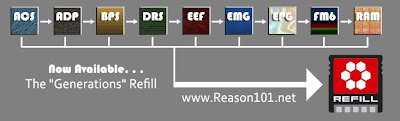
- My favorite part of Generations are the Systems. Systems are multiple combinators set-up in .rns files with corresponding combi-backdrops that show signal flow of the devices. The Evolving Mood Generator, Deep ReGlitch System, Audio Drum Processing... You've turned Reason's rack into a modular beast with these templates! Why did you decide to use multiple combinators set-up in .rns files for these and how did the idea come about for them?

My thinking was that everyone is always focused on creating one-off Combinators to perform specific tasks. Why not integrate these Combinators to construct modular systems out of them. In essence, why not create your own Modular Synth or effects processors out of a string of multiple Combinators?

The other impetus for putting the systems together was the fact that each Combinator is limited to 4 knobs, 4 buttons, and the two performance controllers (pitch and mod wheels). I kept bumping into the hurdle of needing more knobs and buttons to complete some of my Combi designs. So I started by adding another Combinator to be able to tie more parameters to the setup via more Rotaries and buttons. Things just kind of grew from there.

If you read through the Propellerhead User manual, this kind of “external routing” is frowned upon, mostly because you can’t save a Combinator patch which is externally routed (you’ll lose any external connections. But I think this was a mistake and missed opportunity on the part of the Props. Instead, I think folks should be encouraged to build and construct their own systems for their own projects, such that the Combinators interact with each other to produce sounds and FX that could not be achieved otherwise.

That is precisely what I was trying to develop and present with this refill. But while these systems are at the forefront of the refill, it’s important to note that this is only one facet of “Generations.” There are also many different patches, drum kits, synths, arps. etc. which CAN be used separately.

- I'd be re-miss if I didn't bring up the fantastic drum sounds and combinators in Generations. Many of these combinators have great patterns set-up ready for the tweaking. Having recently picked up an Akai LPD-8 pad controller myself, I've had an absolute blast playing with the kits in real time. My favorites are Glitch Box 3, Minimal Super Kit and Electro Drums. What initially struck me with your drum sounds is many of them are melodic sounding, fit so well together and they aren't your typical "drum sounds". How do you generally go about designing drum sounds? Do you have a set idea from the get go of the kit or is it more trial and error and experimentation?

Well let me say thanks for the kind words. I’m really glad you’re enjoying the kits. I had initially wanted to put more kits together, but after developing 3 massive drum combinators with 61 drum sounds each, I had to put it down for a bit. But the next version of the refill will definitely have more kits from which to select.

How do I go about designing the kits. That’s a tough one. I think there are two distinct and different ways I go about designing any sound, not just the drums. One method involves trying to imitate a sound. If that’s the case, I’ll load up that sound or sample in Reason and have it looping in the background on one track, while I attempt to get as close as possible to that sound on another track. This can sometimes involve a single synth, and at others it can involve a whole stack of devices. But the end result is to come as close as possible to that sound. Most of the simple 10-drum kits were developed this way. Trying to mimic drum sounds I have heard.

The second approach is the one I used with the Massive Combinator Super kits. With these kits I didn’t want them to sound like anything I had heard before. So I was not limited by forcing them into drum sounds at all. I just let my imagination run wild, and tried developing distinctive sounds that seemed to work together with each other and work well when used as a “one-shot” drum hit. I should say there was one limitation I imposed on myself and that was to try making them as light as possible so as not to strain the CPU. This is why most of the sounds only use a single Oscillator or single Oscillator and filter pair. There are a few that use more than one Oscillator, but not many. It’s safe to say the massive Combi kits were trial and error. Those kits took more than a little while to put together. But they are also the kits I’m most proud of producing.


- From a sound design perspective the other combis that really struck me in Generations were the Arps, particularly Cinematic Anticipation and FM Madness. Many of your Arp patches in Generations have multiple synths set-up with multiple RPG-8s, some at different rates on different octaves with unique insert settings. This all could have resulted in a complete mess, yet it really works here. What can you tell me about designing these patches? I noticed in many of them you used Stereo Imagers...

The Stereo Imagers are usually used to send different sound parts to different spaces in the patch. The Stereo Imagers are such a great tool to do this. You can send a sound to the back of the mix (Mono) or to the front (Widening). If you think of the performance happening on a stage, generally your drum and bass would be at the back and your synths and guitars would be at the front. This is precisely what the Stereo Imagers do. And so you can utilize them in your patches to replicate this. When working in a Combinator, it’s easy to create one synth or arp to target the back of the mix and one to target the front. That’s the Stereo Imager’s job.

Same goes with the Arps. In some cases, I like to use various Arps running in various directions and then try to hone in on which sounds or Arps go where in the mix. You could even do this with panning so that you have one Arp targeted to the left of the mix and one to the right. Or you can use a combination of Panning along with the Stereo Imagers to create a four corner mix (left back, left front, right back, and right front). I have a tutorial on my site that goes over this process of segregating elements in your mix. You can get very complex if you want to. And generally speaking I like to push the limits of Reason and see how far it can be taken. Not to say that everything is complex. It’s not. But just to see where the experimentation can lead.

- I know this is kind of like asking a parent who their favorite child is... but what combi or device are you most proud of in Generations?

Oh good grief. I really couldn’t say. I can tell you that since I’ve released the Generations refill, I’ve been shifting gears and starting to do more composition and create some new tracks for an upcoming CD I’m working on, and here are some of the patches that keep gaining my attention:

Combinators > Drum Kits > Mamba Jamba
Malstrom > Pad > Trillium
Thor > Synths > Yolongo’s Horns

As well as some of the Thor Textures and one-shots in the Thor > Drums folder. As for FX, I keep going back to the 12-way Filter FX Combinator and Verb Deli under the Combinators > FX folder.


- I love the backdrops for Generations as well as your websites design, do you hire out for your graphic design or do it yourself?

I do the majority of the graphic design myself. Though I have recently used a few stock photos to help promote and market some of my work. And Matt Pearson was the guy behind the design of my most recent “Dream Sequences” EP. We collaborated on a piece where I provided the music and he provided the visuals. He’s a great generative artist who creates these amazingly hypnotic visuals. I remember seeing some of his work online and saying to myself, I must get him to do a video for my track. And surprisingly we found we had common musical and artistic interests. It was the best case of things coming together perfectly between us. I hope to work with him again.

As for the Combinator backdrops and system visuals inside the refill, those are 100% my own graphic design. I needed a proper way to convey the sounds inside the Combinators, and needed a clever way to provide the signal path for the systems. When you have a system which spans 15 Combinators, any help getting you from A to B is going to be needed. This is where I decided to weave the signal path using a set of arrows within the Combinator backdrops themselves.

- Speaking of websites... You started Reason101.net last fall and it's become one of my go to places on the internet for advanced Reason tutorials and information. You have an extensive collection of posts with templates, patches and thoughts on music and music production. First off how's the reception been to your website and where do you get the idea for your different topics?

I’m glad you find the site useful. That means a lot.

I think the reception has been overwhelmingly good. It’s odd really. I think there are a lot of folks in the Reason and Record community who are willing to share ideas and thoughts. This goes against the thinking of a lot of other folks who are very closed-off and guarded when it comes to the tricks of the trade. This has led, unfortunately, to a lot of bickering, infighting, egotistical battles, etc. A side of the industry I find very sad.

It’s because of this guarded nature that topics such as Mixing and Mastering become known as “dark arts,” as if they are some secret concoctions brewed up by witch doctors. What a stupid idea. There’s nothing dark about it. It’s the physics of frequencies. And we can teach each other through methods and tutorials. Wouldn’t it be better if we all benefit from that knowledge instead of stepping on each other to keep it secret? But I digress. . .

I think that as a result of the state of the industry being what it is, when someone comes along to challenge this notion and provide knowledge in a free and open forum, such as Hydlide, Ed Bauman, James Bernard, Peff, or myself (and many others of course), people want to eat it up. It’s like they were starved and now all of a sudden there’s a nice big piece of cheesecake on their plate. Of course they’re going to be happy to have it and enjoy it and savor it. I’m just lucky and happy that I can be one of the ones to provide some of that sweet sticky goodness. Since I’ve been lucky enough to come into contact with others who have helped me along the way, I’m glad I can give something back to the community as well.

I look at the example of Hydlide as a case in point. When I provided the refill to him, I said, “Well, here you go. Do what you want with it. And if you get a chance, put together a song and send it over and I’ll include it in a ‘Demo’ folder on the refill.” A week later, he comes back with 10 amazing tracks that can hold their own. I was thinking “holy shit! You’ve got to be kidding me. And he’s still putting together showcase videos for me, writing a blog article about the refill, and more. I couldn’t have been happier. His songs BECAME the demo section of the refill. Because they deserve to stand on their own, and in my opinion are worth the price of the refill, even if there was nothing else IN the refill. It’s a perfect example of the way we as musicians should help each other out and collaborate with one another. It still shows me what our small community is capable of becoming when we work together.


- I'm always interested in hearing about other people's studio set-up. What makes up your home studio and is there any particular piece of gear your eyeing now and hope to purchase?

That’s a hard one. I tend to keep everything as simple as possible. I know there are those out there with every refill under the sun and every known piece of kit. But honestly, I live by the 90/10 rule, which states that you can achieve 90% of something in 10% of the time and effort, while the final 10% of a project will usually take you 90% of the time and effort. My thought is to get rid of that 10% and try not to worry about it so much. That goes for my music, my setup, and pretty much anything in life. Read The Four-Hour Work Week by Timothy Ferriss. It’s incredibly enlightening for anyone really.

I know that there are those out there that will find this heresy, but you don’t have to have the best setup, just like you don’t have to spend days EQing that one frequency to get it just right. The majority of my work is done using headphones, and sometimes the TV is going on in the background. Shocking! I know. I’ve even been on the bus between Boston and New York using my white iPod headphones mixing away. If I can’t put together a first draft of something within a few hours, I’ll drop it, and move on. That’s not to say I haven’t spent months on a tune before. But just remember if you can’t finish something in a few days or a week, don’t let it drag down your creativity. You have an unlimited supply of creativity. Learn to make the most of that instead of your gear. Get a track 90% of the way and let it be done. Or else hire someone else to work out the other 10% detail work.

So my setup consists of Reason, Record, Recycle, Audacity, A set of really good headphones, two laptops (A Toshiba Qosmio single core, and a Sony Vaio dual core), Novation SL-25, Gretsch Guitar, Line 6 UX input, 2 monitors, and plenty of backup and USB jump drives. That’s it really. Work with what you have and don’t lament what you don’t have. As you can see by my setup, I’m still able to put together production and release-ready music and refills. Don’t focus on what can’t be done, focus on what you CAN do with what you have.

That being said, if there was one thing I would love to own which I don’t already have, it wouldn’t be any hardware or software, it would be more time and a better computer chair with better back support (the former I know I’ll never have, and the latter I’ll have before the month is out).


- In addition to running Reason 101.net, releasing the Generations ReFill, you also somehow find the time to create your own music under the Phi Sequence moniker - which I love the description of on your website- "Ambient Glitch Music for Experimental IDM Minds". In a few of the tracks it almost feels like you have multiple time signatures going on (at the same time). Is this done primarily in Reason/Record? Do you mix and master the tracks yourself?

I appreciate you taking the time out to visit that site and check out some of my tracks. I have not put as much effort into it lately as I would like. All my time has been spent on Generations recently. But now that it’s completed, I’ve gotten back into composing and recording several tracks which will be released soon.

As for time signatures and the music theory behind the tracks, I very seldom pay close attention to the theory. The time signatures in Reason are more there for markers and placeholders, which is nice. But I’ll often start off a track with a set tempo in mind, leave it at 4/4 time, and just start working out some patterns and ideas; trying to get them out as quickly as possible and not stay too long on any one particular sound or track. If you spend more than 15 minutes auditioning different sounds or playing the same track over and over, I feel you get stuck. Better to quickly get everything out and then fine tune it all later. This way it stays fun and interesting, and you often find new ideas out of mistakes along the way.

I often start off tracks by cycling through a random matrix pattern to see what sounds right for the job. I do play parts in as well, so it becomes a combination of both random chaos and controlled order. That’s something I think every track should have. And while I don’t think I go as far as Autechre or Aphex Twin for the chaos that can be found in their tracks, I do have an affinity for glitch mayhem.

Apart from recording various samples through Audacity and now Recycling, everything is done in Reason and Record. I do everything myself for Phi Sequence. From sound design to Mixing and mastering. Though I also use other sounds from other people’s refills as well, when it fits. I particularly like the Lapjockey series of “Flatpack” refills, and Exode’s massive synthesis refill, which is incredibly huge and diverse.


- Reason 5 / Record 1.5 is coming out at the end of August. Kong, Dr. OctoRex, Neptune, Blocks - what are you most excited about and why?

Honestly I’m most excited to give Kong and Neptune a whirl. The Dr.OctoRex, Blocks and Direct Sampling features are all well and good, but to me they are more ways which will streamline workflows that we already use. For example, you might use Audacity to sample something through your mic, and then edit the wav file and bring it into an NN-XT. This has been one of my own workflows since I started using Reason. Now with Direct sampling, I don’t have to go into Audacity or import into the NN-XT. I can do it straight inside the NN-XT. It doesn’t add anything new. It just streamlines something I’ve already been doing.

With Kong and Neptune, I think there are several additional possibilities inside Reason, some of which are not obvious upon first glance. If you are a sound designer, however, you can use Neptune to process your synth sounds – not just vocals. There’s one idea. And in Kong, you can create some new and interesting drums based on Modeling synthesis. To me, those are the most exciting features. The rest is nice and all, but not mandatory for my own workflow.

- Who are some of your favorite musicians and where do you find inspiration for your own sound design and musical creations?

I get inspiration from everywhere. One of the best sources of inspiration comes from the people who participate in the various internet forums and communities. Many of their questions can eventually turn into articles on my blog. For instance, recently someone was asking how to turn the Combinator buttons into radio buttons so that if you had 4 devices, and each of those devices was connected to a button (turning the device on or off), could you then switch from one device to the other using the buttons). No easy feat. But when I was able to work out how to do this, it dawned on me that this might be a good topic for a tutorial. There’s one kind of inspiration.

Musically, I love anything Ambient, Experimental, Glitchy, Dub, Reggae, old school blues, and really anything that musically inspires me. I think a big key here is that I tend to gravitate to bands that are very much against the mainstream. Mum, The Orb, Future Sounds of London, School of Seven Bells. I truly appreciate any band that can go against the current trend of popular music and find their own voice. It takes a strong will power to do that. But I also think it’s the most rewarding musically.

I also find inspiration in areas outside music. The works of artists such as Jackson Pollock, Johannes Vermeer and the Dutch painters, J.K. Potter, Darwin Wiggett, and Matt Pearson are just some of the many artists I appreciate and find inspirational. They play a huge part in the finished product of my music and my sounds.


Thanks for the great interview Rob! Pick up your own copy of Generations at www.reason101.net today for the low price of $49 USD.

Saturday, August 7

10 Questions with Harald Karla of Soundcells!


Harald Karla of Soundcells does things a little differently than other sound designers. While other companies are sampling big name synthesizers for the thousandth time he searches out original sound sources like the Amiga 1200 computer and LL Electronics Rozzbox synthesizer and ignores current dance trends in favor of tone and sound. His Bitbumper Deluxe was one of the very first refills I ever bought for Reason and it's still one of my most used! In this interview Harald touches upon his own music creation, his work at Soundcells and his beginnings in music.

- Who's behind Soundcells and where are you based?

The “heart” of Soundcells lies in Germany, about an hour’s driver from Cologne, in a somewhat more rural area. As the main person behind Soundcells, I am the one who’s coming up with themes for ReFills, takes care of the full realization of a ReFill. In addition, I am responsible for most of the demo tracks. Towards the end – when a new set is about 80 – 90% finished – more people come aboard, mainly to beta test the set. Although I meticulously take care of all details, from the labels for buttons and knobs to the correct functioning of all parameters assigned to the Combinator, it’s easy to miss that one mistake. This is where a new set of eyes and the general distance of others really help.
I also appreciate the help I get with the production of additional demo tracks. Everybody’s individual approach to this is clearly reflected in the result, thus improving the tonal presentation of the products.

- What was your first instrument and how did you get into sound design?

It all started at the age of 6 or 7 with an harmonica which I taught myself to play, and I continued to do so for some time. Pretty soon I developed an interest in electronic sound generators. Accordingly, on the radio the songs I liked the most were those that featured these “new electronic sounds”. It must have been at the age of 10 or 11 that I got increasingly interested in keyboards, which were becoming more and more common at that time. It was only a few years later that I owned my first one. Looking back it’s kind of interesting that it was not the hottest Yamaha device from that time (which already featured sample-based drums), but a slightly older model which, however, allowed to fiddle around with tone colors.
That just wasn't enough and two years – an a hard vacation job – later it was replenished with a first synthesizer: A Yamaha DX100. Probably not the most fortunate beginning regarding ease of use, but I didn’t know anything else anyway, and hey, after all it was the DX7’s “little brother” :0). And so even the small, unlit 2x16 character display couldn’t keep me from creating my first “own" sounds the very first night. From that time it just never stopped…
In 2006, “Mystic Dream Pads Vol.2” (which is now, along with MDP4 and MDP5, a full component of “Pads - the BIG box”) came out as my first ReFill for Reason.


- Your refill Analogue Signatures v.2 has samples from a Moog Source, Korg MS20, and the Waldorf Microwave 1 synthesizers. What gear do you use for Sampling and how do you get such great sounding samples?

There is really not much to tell, and definitely no big secrets involved here. For several years now I’ve been using a pretty average but solidly working M-Audio Delta 1010 card. Prior to the actual sampling – and maybe that really is the secret – everything is routed through an old analogue MACKIE SR24-4 board. It’s actually nothing special, but maybe that’s that certain “analogue feeling” :0). Quite frankly, I don't think too much about it – use some reasonable synthesizer settings, set levels to optimum and send everything straight into the computer. In case I have to choose the finest from several samples, I’ll pick them very spontaneously and instinctively…

- The Simple Sampling Refill samples instruments from a Stylophone to a Doepfer MS-404 to a mini kalimba - how do you decide what kind of refill you're designing and what instruments you'll sample?

Usually, the direction into which a ReFill would develop comes up quite spontaneously as well. The idea behind “Simple Sampling” was basically a pure Stylophone-based ReFill designed as a Christmas gift for customers. However, merely a few demo tracks with one Stylophone sound appeared to be somewhat meager – so some additional “helpers” needed to be thrown in. Since that ReFill was a really impulsive idea and the timeframe being accordingly tight, it had to be kept as simple as possible but without a lack of quality. So elaborate multi-sampling just wasn't an option… - an idea for a name and some additional content of the ReFill was born. I had finished sampling of the MS404 quite a while ago and that 5-tone mini kalimba had also been waiting on my hard disk for some time…
When I am searching for topics for a new ReFill, I usually ask myself what soundset I would find interesting or if there is anything I miss so far... Most importantly, there should always be a good reason for creating and also publishing a new ReFill.

- I dig your website as well as your combi backdrops, do you hire out for your design work and/or do you have a hand in it?

It’s sort of a mixture of both, really – a large part of the backdrops and product images comes from the time in which the ReFills were not generally created for Soundcells. Luckily, it’s not a problem to continue using them. For others, I’ve had new backdrops created during the making of the Version 2 editions. The hardest thing with that has always been putting my own ideas into words – this means there is no chance of trying and fine-tuning the results. Also, data handling is done by somebody else, making small changes (which I would usually take care of myself) much more difficult…
As a consequence, I meanwhile decided to handle it all on my side. At the moment, I take full responsibility the website design. For the product texts, however, I’ll just provide some guidelines and then rely on external support.


- One of the coolest things Soundcells does, in my opinion, is continually upgrade their products. bitBUMPER Deluxe v2 for example has 130 new combinators from some new sources. How's the reception been to your renewed products?

Well, bitBUMPER deluxe v2 is actually an exception – the average update includes about 10 - 20 new Patches and usually some minor improvements or adaptions. There is no unique rule as to when an update will be created or how elaborate it will be. For example, if the basic programming of a Combinator patch has changed, these changes (as long as they can be realized with reasonable effort) will become part of the update. Also, there is always potential of improving the graphics – so why not put that into a ReFill update?
Moreover, Version 2 editions are a nice opportunity to tackle the extension of existing Refills with a “fresh set of ears”. The high point of all this is that these updates are always free for users of the previous version :0))

- Speaking of bitBumper, BB features samples from a Rozzbox synthesizer! The Rozzbox is boutique synth I've always wanted to get my hands on, did/do you own one or did you borrow it for the refill. And what did you think of the Rozzbox?

I consider myself lucky to own a Rozzbox V2 – a wonderful synthesizer with a lot of character, a very individual sound and also pretty complex – at least since version 2. The RB offers some features not easily perceived at first sight, making this synthesizer a *really* outstanding device. The Rozzboxes’ behavior is far from being perfect, but it always sounds so distinctive – and that’s exactly one of the features that make this little box so hot. There’s plenty of ways to create a complete and awesome ReFill using nothing but the Rozzbox V2.


- You also a record under the name Jonson and have 3 releases under your belt! What gear do you use in your own music production and does Reason and Record play a role in it?

Oh my, that Jonson website is really calling for an update… :0)
For album work, I also tend to set up some sort of objective. For example, the entire first album “Chiplandschaften” was made using a Yamaha A5000 Sampler which was in turn loaded with samples from an AMIGA 1200 – 15MB of 8 bit samples and one sampler – that was it! (With reverb being the only external effect.) It was a really gratifying experience to NOT use all this equipment I had at hand, but rather rely on these limited resources and just be creative. I wasn’t using Reason at that time.

Album No. 2, "p_composing", was almost entirely produced on a computer using softsynths, but I wasn’t using Reason at that time either (about 2004-2006).

For “Mindlock”, however, it’s been the other way round. I had discovered Reason at that time, created my first ReFills and so I was already pretty familiar with this software. This album is 100% Reason, and version 3, that is. So far, nobody complained about the sound – quite the opposite :0) In general, I think that Reason / Record is really underestimated. Although I have to admit that I also regarded the software as a toy for quite some time…

The Combinators introduced in Reason 3 made me change my mind, however. Pretty soon, R & R became my favorite software until today, the Combinators are a powerful tool, and R & R offers a higher degree of modularity than you would expect.

- Reason 5 and Record 1.5 have just recently been announced, have you had a chance to test the betas and what are you excited about in Reason 5 and Record 1.5?

Of course I checked out the betas – all new features are mentioned on the Propellerhead website, anyway. Basically, it is once more a big step towards a direction which R&R did not support until now – Kong offers a wider range of tonal options and Neptune allows much more that just editing the voice...an that’s because you can rewire just as you like. It’s probably the numerous small improvements which you don't want to miss after a while. Sure enough there are still some things that would be nice to have, but there is general improvement and most likely the new versions will again run incredibly stable so that you tend to forget to save things every now and then – and to me, this one of the major advantages of this software.


- Your ReFills run the gamut from lo-fi to ambient to classic analog sounds. Who are some of your own musical heroes and where do find the inspiration to release such cool products?

There are no particular icons. In my early years, I used to listen to everything that hit the charts, the preference – as mentioned earlier – being songs with a “clear electronic focus”. A few years later my interest turned towards the “Pat Metheny Group”, an influence that is reflected in my sounds and songs from that time.

On the one hand, my inspiration for ReFills or sound design in general is simply based on a passion for (electronic) tonal colors. On the other hand, I have seen many excellent synthesizers throughout the years – with often just mediocre default presets, cobbled together in boring and uninspired way. Soundcells ReFills are the exact opposite: The patches can be used to “play around with”, they are often quite adaptable and programmed with a lot of attention for detail. According to my definition, a good soundset has to have the potential to inspire. No matter if a particular sound has to be swapped or edited at a later point, it still served as an important source of creative ideas. The range of different sound styles in a ReFill simply matches my personal taste.

- Your latest release, Digital Genome, features sounds from an old Commodore Amiga 1200 computer! I'm really impressed with the demos (check out Karla's "The River" and Adam Fielding's "Looking Back"). While I'm old enough to remember the Amiga computers I never actually owned one, though I do know there were a few trackers made for them like OctaMED. What was it like working with the Amiga 1200 and what software did you use to design the sounds on the Amiga?

Funny enough, I never actually worked with an Amiga 1200. I got hold of this computer by coincidence – at a time when most people had long since lost interest in the Amiga and the like. As I was still using an Atari then, I found the Amiga quite fascinating. It was the tracker scene existing around this computer with its sometimes highly interesting and truly creative demos (i.e. videos with, I guess, 4 track audio) which finally led my way to several programs. I then used one of these programs (AHX) to make the Amiga play tones and short sequences. These were then recorded on a Yamaha A5000 sampler whose awesome filters and unconventional effects helped to finally bring the sounds to life. I recorded a first track based solely on these samples and the sound was so fascinating that the idea was born to produce a whole album exactly this way. Towards the end of 2008, these samples were recorded again. This time with the objective of creating some kind of a “Chiplandschaften” ReFill – “Digital Genome” taken literally.

- What are you currently working on and what can we expect from Soundcells in the future?

“Salad Bar” version 3 just came out, the next month will see a version 2 of “Afterglow”. New ReFill projects are hardly more than concepts in my head, so I won’t give away anything of that right now… In general, I don’t intend to publish more than two or three new ReFills per year, just because a good set takes its time and, of course, the content has to make some sense.
In the future, Soundcells will continue to focus on ReFills, although there are plans to offer soundsets for softsynths and maybe some sample packs as well. Whatever the outcome will be, new sounds or sets will have to fulfill the aforementioned inspirational requirements - no matter what format will be used… There will definitely be no ReFills or soundsets following an trend or fashion.


Thanks for the great interview Harald! As a special treat to Resonant Filter customers Harald has offered a 20% discount to RF readers thru the month of August! This discount is good on all Soundcells products and redeemable with the coupon code "resonantfilter".

Sunday, July 4

10 Questions with James Bernard!


This past week marks the 1 year anniversary of Resonant Filter and to commemorate that I thought we'd go for the gold and do an interview with none other than James Bernard! As Propellerheads Product Specialist, James has the kind of job gear geeks like myself dream about... Helping big name stars like A Guy Called Gerald out with their Reason based DJ set-up, traveling around the world doing seminars, and designing sounds for the software we all love! I wrote up a list of questions for JB just as Propellerheads announced Reason 5 and Record 1.5, he was kind enough to delve into his past as an artist on Wax Trax, work with Korg, as well as his current job with Propellerheads. Check it out:

- What's your background in music and where did you grow up?

I started my musical journey learning trumpet in elementary school… then quit when I saw a picture of Dizzy Gillespie and thought that is what happens to your face when you play trumpet for a long time. (hey I was young…) Then I picked up piano, bass and most recently guitar - all self taught. Also, my father has a school which teaches audio engineering and I took the course right out of high school while I was working for Korg.. so my proper schooling is all in audio engineering. 

In the late 80's - early 90's I was involved in the NY area Rave scene and that is where my interest in producing/listening to electronic music started. I was just starting to tinker around with my own productions, and the early Rave and Acid house, combined with Industrial music from the 80's was the stuff that started me producing electronic music… funny thing is.. when it finally came to the point where my music was getting released by record labels.. I stopped going out to parties and barely listened to anything electronic.. I was listening to classical, The Cure, David Bowie, Phillip Glass, This Mortal Coil and stuff like that… then I would go and compose a 140BPM acid tune!

- Reason 5 has just been announced, Record came out recently, not to mention Rebirth for the iPhone - how much say do you, as Propellerheads Product Specialist, have on new products and developments at the company?

Actually I do not have any "say" in the products directly.. but I do offer suggestions on features as well as usability. And I also was part of the sound design team for both Reason 3.0 and 4.0 and did many patches and some samples (Glitch Kits and loops!) for the Factory Soundbank.

- I know from reading the Wire to the Ear blog that part of your job at Propellerheads is with artist relations.  How do you generally find out if an artist is using Propellerheads software?  And do some of them want to keep it on the down low?

I wish there was an easy answer.. sometimes the artist emails us directly, some of the time it is from finding out from other artists and some times it is totally from my searching in our database and cold emailing/calling an artist. There are more than a few who do not really do interviews/stories and prefer to keep their name "out of the pool" of artists that we promote… fair enough.


- You used to work for Korg,  what was it like coming from a hardware based company to software?  And how does that work with Propellerheads being headquartered in Stockholm and you living in Florida?

I have much respect for Korg products over the years (the Legacy Collection was my last sound design project) and still have a good relationship with those guys… but when I realized that I was using less hardware and more software in my own productions I knew it was time for a change. Plus.. I gotta say it is great to work with a company who actually enjoy making people's musical endeavors easier and more fun.

My job with Propellerheads involves a fair amount of travel and when I am not on the road I am at home doing the artist relations stuff and now the 52 tips videos.

- Speaking of Korg, I read on your myspace page that you did sound design work on the original Electribe boxes.  I've been a fan of the Electribe since picking up an ER-1 a number of years ago.  Those were all pretty big sellers, I'd imagine you've heard your programming on a lot of songs just thru that alone.  Is it still a kick to hear someone use your work in their own songs?

Oh yeah.. if I had a dime for each time I have heard not just a sound but the ENTIRE PRESET PATTERN OF MUSIC that I wrote on those boxes in someone else's track I would be a rich man. Seriously… why just use a preset pattern without making any sort of change? What does that say about your dedication to your craft? That being said.. the initial excitement of being part of those products and hearing them get used quickly wore off.


- While a lot of music software and hardware companies have relative unknowns demonstrating their products I think it is so cool the Props have someone of your caliber on the payroll doing seminars, videos, etc.  Tell us what your job as Propellerheads Product Specialist entails and what's an average workday like for you?

Thanks! Though I'm not sure what my caliber is these days ;-)
My average workday varies on the task at hand.. though it always involves a lot of time in front of a computer screen. The job as a Product Specialist has changed a lot.. used to be traveling to stores and trade shows doing demos mostly… now it is much more based on internet content (videos), hosting my Facebook page, being a presence on the forums and being very accessible to the global user base via email and such.

- As most people know you're an accomplished musician yourself,  having released records both as a solo artist under the guises of Influx and Cybertrax and as part of the popular duo Expansion Union.   What gear do you use in your own music and what kind of home studio set-up do you have?

Well.. obviously all of our software and some extra bits and bobs of software, d16 plug ins, dBlue Glitch, Korg Legacy Analog and Digital editions and other plug ins I can't remember.. though I don't use a lot.. and some Ableton Live as well. I also still have some of my vintage hardware and some borrowed from friends like my TR-606, TB-303, MC-202 and some recent lo-fi DIY stuff (BugBrand, Bleep Labs), a few guitars and bass guitars and most recently have been putting the starting touches on a DIY Euro Rack modular system.. though I am just getting the case, rack, bus board and PSU parts together at the moment… no modules yet!

- Speaking of music, who are some of your favorite artists? 

Wow.. that's a tough one.. If I only have to name a few? Bowie/Eno (Low, Lodger Heroes era), Phillip Glass, Radiohead, Plaid, Squarepusher, Jaco Pastorius, New Order/Joy Division, Bauhaus/Tones on Tail/Love and Rockets and Chopin.

- I know you started your own record label, James Bernard Music, as a result of legal troubles with your old label TVT/Wax Trax! What advice would you give new acts concerning signing to record companies and in the age of the internet do you think record companies are even necessary anymore?

Advice? Don't sign ANYTHING without having a music attorney look at it, don't sign anything long term and try and get as much of an advance as you can because royalties never come unless you are like a top 10 artist. Actually these days I think that not signing with a label and doing it all DIY is the best way to go. The one thing you need more than a label is someone who is good at promoting your music and getting people to take notice… that is the most valuable thing right now. I do not plan on signing any more record deals in my lifetime.. and actually more and more of my music is ending up being used for TV/Film and less as actual releases. That's an area of the music industry where you actually DO see royalties.

- I absolutely love your Casiotone MT-400V ReFill of drum beats, I have a Casio MT-68 myself.  Any chance you'll be making a refill of the accompaniment patterns for the MT-400v?  That's my absolute favorite part of my MT-68!

I had thought about sampling them when I did the drum beats… the tricky part was that since there a few variations it would have required lots of Dr. Rex players.. maybe now with Dr. Octo Rex it would be a bit easier to do… but finding the time to do it is the hardest part.


- Your 52 Reason/Record Tips videos are something I look forward to every single week.  Where do you get the ideas for topics on the series?

Some ideas come directly from email suggestions of viewers, some from lurking in our forums and some from the archives of my own production techniques.


- I dig the JB logo you have on your lulu store page who designed that for you?

Me! It's using a font that I have forgotten the name of now.

- I've got to ask one more question about Reason 5 and Record 1.5 - what new device or tool are you most excited about and why?

Honestly? All of them! In Record it's Neptune and the new Stretch Tempo to Clip Length function (instant apex twin!). In Reason 5 it's Kong, Sampling, Dr. OctoRex and Blocks… though there are some great things that were first introduced in Record (on Screen Keyboard, Explode Note Lanes, etc.)


- The last record you released "My Beautiful" was done last spring for your wife, Nicole, who was 7 months pregnant and fighting Acute Myeloid Leukemia at the time.  I read on your facebook page that Asher (coolest boy's name ever!) is now 1 years old!  First off I hope your wife is doing better.  My question, or more of a thought, is how music can be a place of solace in time's of distress and how society seems to negate that power of music largely in favor of fashion and the latest dance craze.  Any thoughts? (yeah, ignore this question if you want - I came up with it after going to my Mums grave over Memorial Day.) 

Thanks. It has been a rough journey and it still continues.. Nicole has good weeks and bad ones… hopefully now we are in the place where there are more good than bad, which has not been the case for the past year.

Music for me has always been my release, my therapy, my best friend when nobody else is around. Regardless of the latest fad.. for me it always comes back to.. what do I FEEL when I listen to this piece of music .. do I only connect it to some visual that was force fed in a video or do I actually feel the message or story that the musician/artist was trying to convey/release/depict. I think that there is still great music being made.. it's just not the stuff that is being pushed as a product by most major labels. 

I know in my life, if it was not for music, I would not be alive… and I mean it.

- Your a father, musician, product specialist, and husband - where do you find the time to do everything you do?

I'm actually still trying to figure that one out… The trick is to be extremely efficient with every minute you have to spare… oh… and don't sleep.


Thanks for the great interview JB!